
KDOC Releases After Anderson Sentences
Kentucky Department of Corrections institutions and contract beds form a statewide system for sentenced offenders. No state prison is located in Anderson County. A felony judgment from Anderson Circuit Court can result in placement wherever KDOC assigns the person, including a state prisoner temporarily held in a local facility.
A KDOC release can lead to parole, probation and parole supervision, mandatory reentry supervision, conditional discharge, another agency, or sentence completion. The exact displayed category should be preserved. A community-office location means the person is outside prison under a shown supervision relationship; it does not mean the sentence and all supervision ended.
A regional-jail movement into KDOC custody is a transfer, not a community release. Conversely, a state Daily Releases entry can show departure from a listed institution while KOOL explains whether another status continues. The Anderson County released inmate search connects state results with the Anderson case record.
Search KDOC Releases in KOOL
Kentucky Offender Online Lookup, or KOOL, is broader than a live prison roster. It can show state prisoners, state-controlled people held locally, probationers, parolees, other community placements, and absconder markers. It is not a complete record of every person who bonded out of Franklin County Regional Jail.
- Start with a last name and first-name fragment, then narrow only when needed.
- Match the person by DOC or PID number, age, aliases, conviction county, and dates.
- Open the detail and copy the exact offender status, location, and check date.
- Read sentence and parole labels separately. Do not convert eligibility or a proposal into release.
- Check Daily Releases when an actual state departure date is known.
| KOOL display | Meaning |
|---|---|
| Active Inmate with prison location | Still physically confined in state custody |
| County-jail location | State-controlled person may be housed locally |
| District 12 community office | Outside prison under a displayed supervision relationship |
| Released To Other Agency | Custody transition requiring the receiving agency |
| ABSCONDED marker | Alleged supervision status, not a new conviction or current jail proof |
| No result | Inconclusive; identifiers, custody scope, or finalization may differ |
KDOC says KOOL data is updated daily but warns that information newer than 120 days may not be finalized. Record the “as of” context and return to the originating agency when the result is ambiguous.
KDOC Projected Release Labels
KOOL uses several sentence dates. The advanced search includes a “Projected Release Date” range. The individual record can show Expected Time To Serve, Minimum Expiration of Sentence Date (Good Time Release Date), Parole Eligibility Date, Maximum Expiration of Sentence Date, and a Proposed Release Date in parole information.
- Minimum Expiration
- A credit-sensitive good-time release calculation.
- Parole Eligibility
- A point when review may occur, not an actual release.
- Proposed Release
- A conditional parole-related date that can depend on plan approval and processing.
- Maximum Expiration
- The outside sentence endpoint displayed by KOOL, subject to lawful recalculation.
- Actual Release
- The recorded departure confirmed by the release record or Daily Releases.
KRS 197.045 authorizes sentence credits, including specified prior-confinement, education, program, and possible good-behavior credits. The statute does not promise every eligible person an automatic maximum credit. Credits can be withheld or forfeited, jail credit can be corrected, consecutive sentences are aggregated, and special offense rules can alter the result.
The 85 percent rule is not universal. KRS 439.3401 defines covered violent offenders and generally limits specified early-release routes for covered terms of years. The offense, sentence, exception, and effective date must be checked before applying it.
Confirm KDOC Daily Releases
The KDOC Daily Releases archive publishes date-based reports. A matching row can provide the DOC number, release type, and released-from location. It is strong evidence of departure from the listed state-controlled institution under the stated type.
The official archive shows the route to the date-specific reports used for Anderson County state-release confirmation.
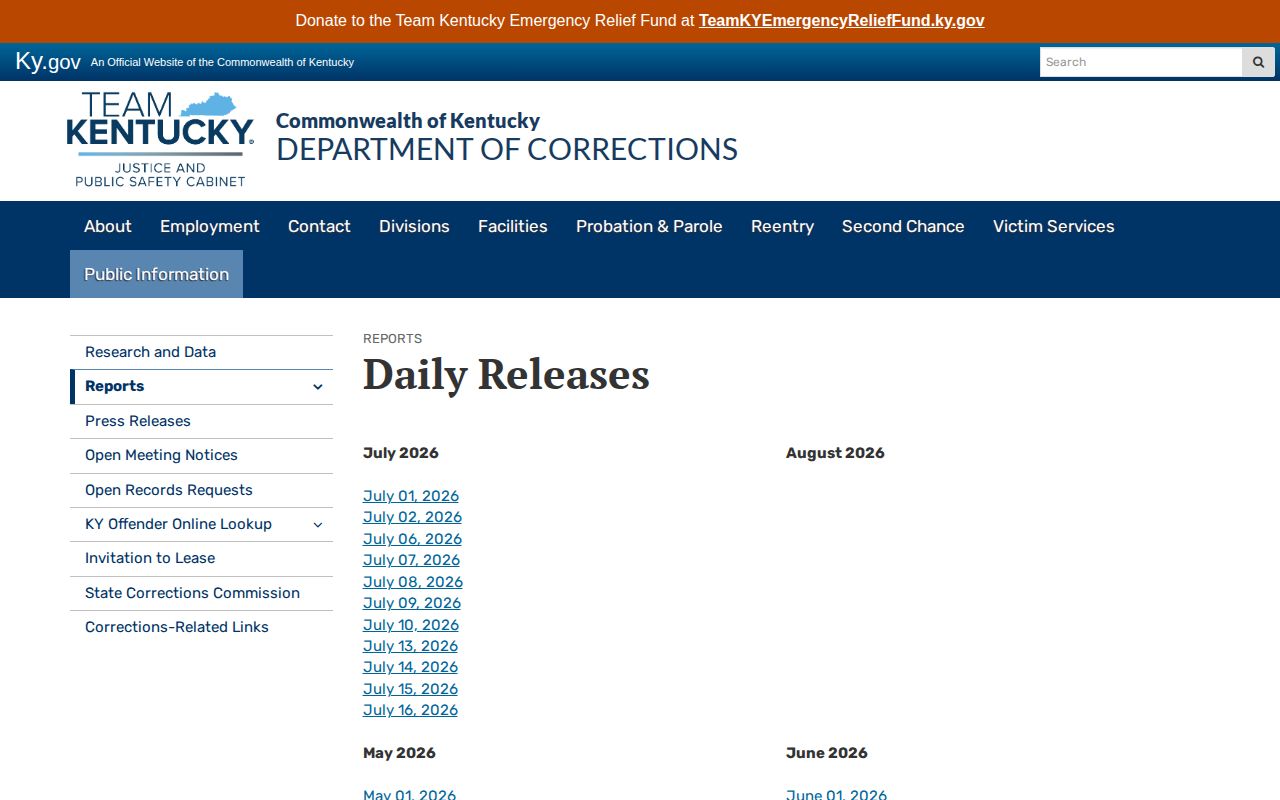
This archive should be paired with KOOL’s current status because a state departure can lead to community supervision or another agency rather than complete discharge.
Daily Releases does not cover every FCRJ bond-out, recognizance release, or short local custody episode. The custody system controls the source. Use the regional jail’s booking and release record for a purely local event.
KDOC Parole Records and Release
The Kentucky Parole Board decides parole matters; KDOC administers community supervision. A Board grant is favorable action, but physical release may still depend on plan approval, detainers, conditions, and processing. A deferral delays review. A serve-out directs continued service. A rescission withdraws prior action, while revocation can end community parole after violation proceedings.
The Board’s schedule page says eligibility hearings occur weekly. Monthly calendars and eligibility lists announce proceedings, not actual releases. Kentucky does not appear to publish one complete standalone decisions-search database. Use KOOL’s person-level parole table and the Board’s open-records route for a releasable decision.
KRS 439.340 and applicable regulations include offense, sentence, and effective-date exceptions. A universal percentage should not be advertised as an Anderson person’s eligibility or release date.
Anderson KDOC Supervision Office
Anderson County community supervision is assigned to KDOC Probation and Parole District 12 in Frankfort, not a Lawrenceburg office. KOOL may identify that community location. District 12 is the timely verification route for public supervision information after the prison phase.
2439 Old Lawrenceburg Road
Frankfort, KY 40602
Mail: P.O. Box 2400, Frankfort, KY 40602
Phone: 502-564-6613
Fax: 502-564-9397
The official District 12 page displays the Anderson County supervision assignment.
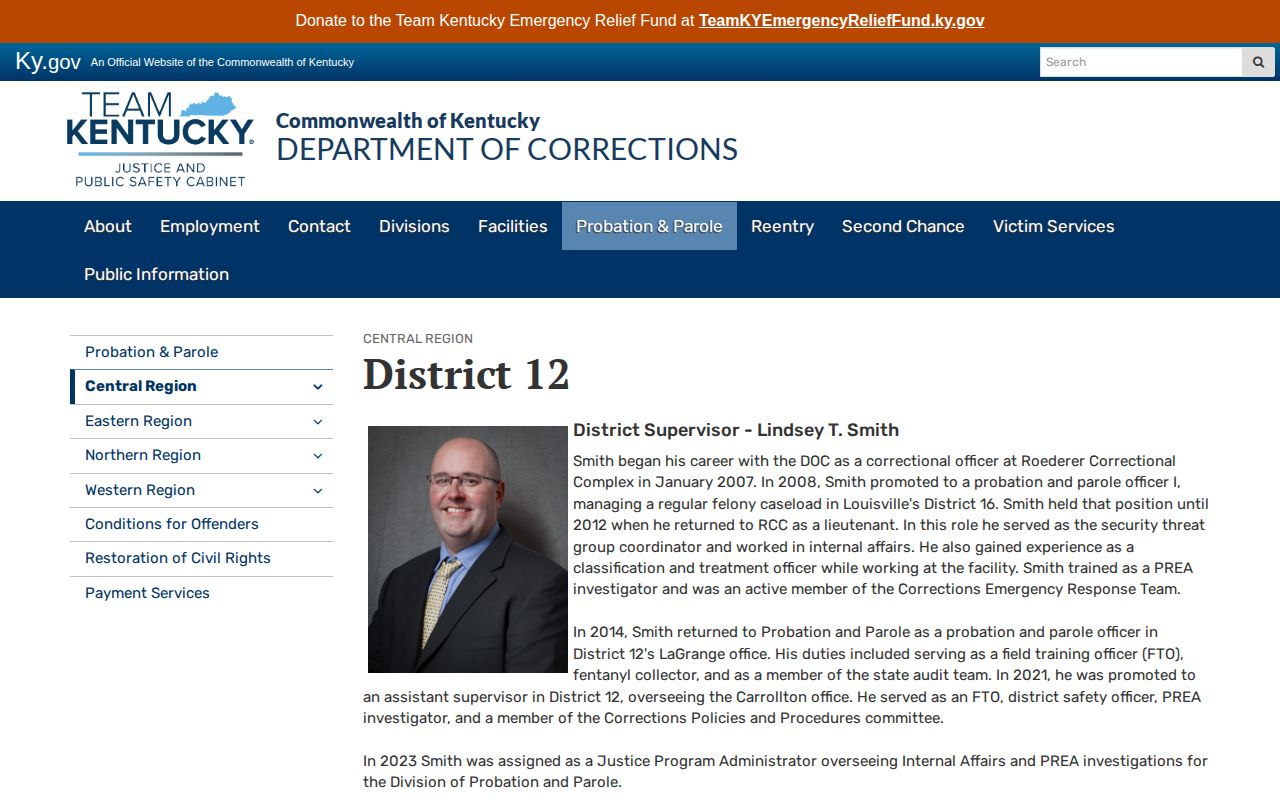
This office confirms community status when KOOL is unclear, but it does not replace the Daily Releases entry or institution record for the physical departure.
Request KDOC Release Records
Use KDOC’s official open-records process for state sentence calculations, releasable status documents, and state custody records. Identify the person with DOC or PID number, full name, date of birth, Anderson case number, and the specific existing record sought. Avoid asking the custodian to create a new calculation or narrative.
Kentucky’s Open Records Act, KRS 61.870 through 61.884, provides access to public records subject to exemptions. KRS 61.880 generally requires a written decision within five days, excluding weekends and legal holidays. That response period is not a guarantee of immediate production for stored or complex material.
Ask for nonexempt portions after redaction if part is withheld. A denial should identify the legal basis and explain its application. The Kentucky Attorney General’s open-records guidance provides the official review route.
Resolve KDOC Record Conflicts
When records disagree, identify the custodian, custody episode, timestamp, and status meaning. Match DOC or PID numbers rather than name alone. Compare actual departure with projected release, parole eligibility, proposed release, court disposition, and update dates. Read any receiving-agency or destination field before calling the event a community release.
A DOC Daily Releases entry is strong evidence of state departure. KOOL explains whether supervision or another status followed. A Parole Board grant, proposal, or eligibility date precedes release and cannot replace the actual record. District 12 addresses supervision after the prison phase.
Save the date checked and source URL because records change. Obtain the signed Anderson court order or KDOC release sheet if dynamic sources remain ambiguous. Respect later sealing or expungement orders rather than using a stale copy to bypass lawful access limits.
Search Public Records
Sponsored Results